Best Home Hydroponic Systems UK (2025): The Complete Buyer's Guide
Growing food without soil sounds like science fiction, but hydroponic systems have become genuinely practical for UK home growers. Whether you're after fresh herbs on a windowsill or serious vegetable yields in a spare room, there's a hydroponic setup that works for your space and skill level.
The appeal is real: plants grow 30–50% faster than in compost, you use 90% less water, and you sidestep soil-borne pests and diseases. The trade-off is a bit more technical knowledge and an upfront cost. But if you're serious about self-sufficiency or just tired of supermarket basil turning brown in the fridge, a home system pays for itself within a few seasons.
This guide covers the main system types you'll find in the UK market: deep water culture (DWC), nutrient film technique (NFT), ebb-and-flow, and countertop units. Each has genuine strengths and weaknesses depending on what you want to grow and how much space you have.
Deep Water Culture (DWC)
DWC is the simplest system: plants sit in net pots above a tank of nutrient solution, their roots dangling directly into it. An air pump keeps oxygen flowing, which is critical—roots need air as much as water.
Pros: Dead simple to build or buy, very cheap if DIY, excellent for leafy greens and herbs. Once running, it's hands-off; you're mainly checking pH and topping up water.
Cons: Temperature matters—water warms up easily in summer, which can rot roots or encourage algae. You need an air pump, so there's a small ongoing electricity cost. Not ideal if you want to grow anything heavy like fruiting tomatoes; the root mass gets too heavy for the system to support cleanly.
Best for: Lettuce, spinach, basil, coriander, and other fast-growing leafy crops. Student budgets and small spaces.
Nutrient Film Technique (NFT)
NFT uses a slight slope to keep a thin film of nutrients flowing constantly past plant roots in channels. It's more space-efficient than DWC because you're growing vertically, and you can stack channels.
Pros: Space-efficient, lower water usage than DWC, relatively affordable. Popular in commercial setups, so parts and expertise are widely available.
Cons: The pump has to run constantly—if it fails, roots dry out fast. The channels clog easily if you're sloppy with nutrients or don't change the solution regularly. Not forgiving if you go on holiday. Temperature swings cause problems because there's less thermal buffering than in a large tank.
Best for: Greens and herbs on a budget. Growers with reliable electricity and who can check the system every couple of days.
Ebb-and-Flow Systems
This is the "flood and drain" approach: a pump floods a growing bed with nutrients every few hours, then drains it back to a reservoir. It mimics tidal action and works for heavier plants.
Pros: More forgiving than NFT if the pump fails—plants can survive a day without water. Works for a wider range of crops, including fruiting ones like tomatoes and peppers. The periodic flushing keeps algae and salt buildup in check.
Cons: More expensive than DWC, more parts to maintain (pump timer, drainage), higher electricity use. Requires careful setup so water actually drains properly; bad sloping means root rot. Messier than closed systems if you have a leak.
Best for: Growers who want variety, serious vegetable production, or anyone planning to move beyond herbs.
Countertop Units and All-in-One Systems
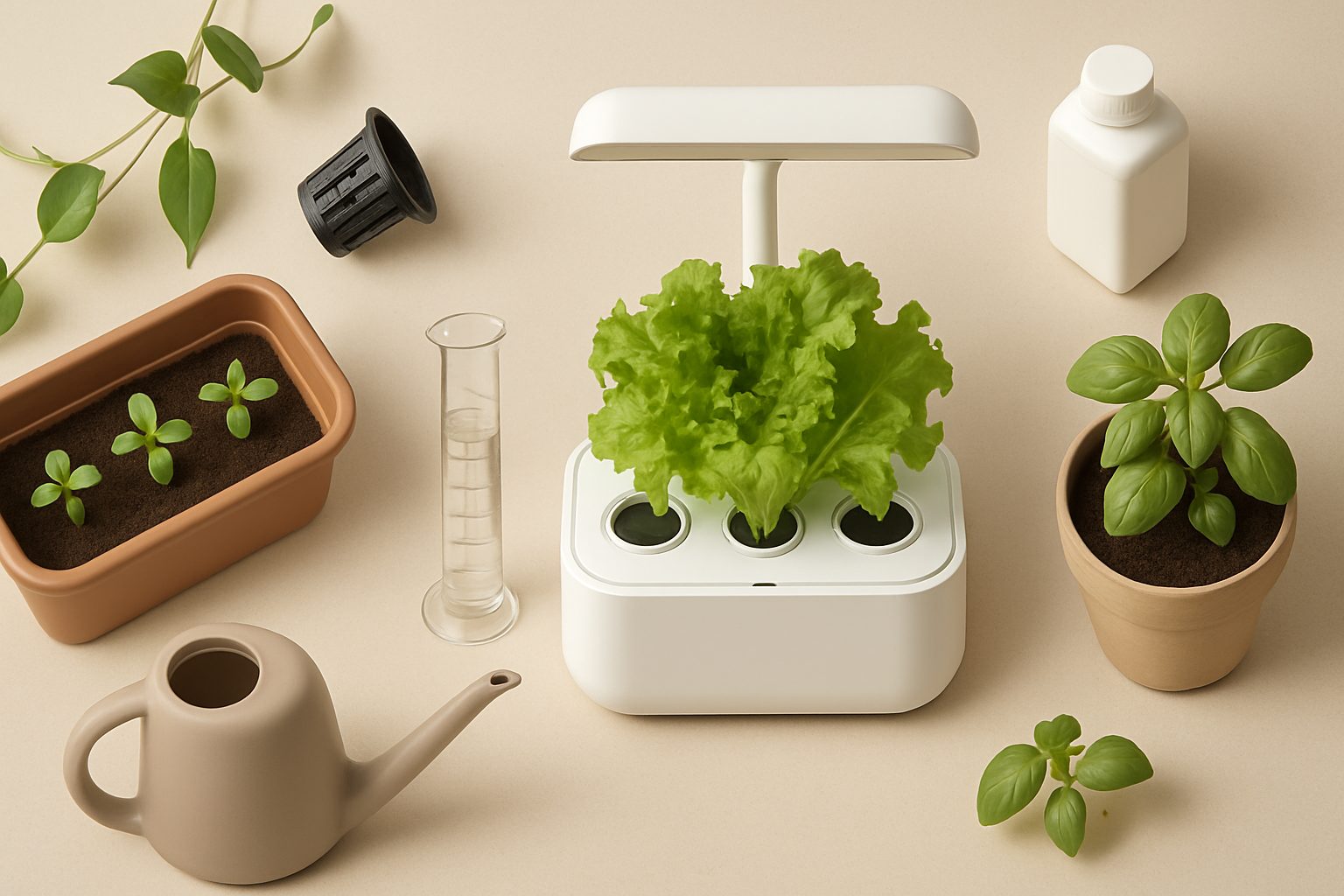
The market has filled with compact units—AeroGarden-style devices, sleek tabletop farms, and plug-and-play setups. These appeal to beginners because they bundle everything: lights, nutrients, timer, pump.
Pros: No assembly, minimal learning curve, small footprint. Some designs are genuinely attractive if you care about kitchen aesthetics. Reasonable performance for what you pay.
Cons: Expensive per plant or per growing season compared to DIY. Nutrient cartridges are proprietary and pricey. Limited crop flexibility—you're often stuck with the company's seed options. They scale poorly if you get serious; you'll outgrow them quickly.
Best for: First-time growers, windowsill growing, testing whether hydroponics is actually for you before spending on a larger setup.
What to Consider Before You Buy
Space and light: How much room do you have? Will you need grow lights, or is a bright windowsill enough? Artificial lights are essential for most UK homes unless you have a south-facing conservatory.
Electricity: All systems except passive solar needs power. NFT and ebb-and-flow need it constantly. Budget £5–15 per month depending on lighting and pump size.
Maintenance: How often can you realistically check the system? DWC and simple setups demand attention. Ebb-and-flow is more forgiving.
What you want to grow: If it's just basil and lettuce, DWC is overkill. If you want fruiting crops or longer-term growing, ebb-and-flow is more practical.
Budget: DIY DWC costs £30–80. A decent NFT or ebb-and-flow system runs £150–400. Countertop units are £200–600+. Factor in ongoing costs for nutrients, electricity, and eventual replacement parts.
The Takeaway
There's no universally "best" hydroponic system—it depends on your priorities. If you want to start cheap and learn, build a DWC. If you've got a bit more budget and want flexibility, ebb-and-flow scales better. If you want convenience and don't mind paying more, a countertop unit gets you growing fast.
The good news is that even a budget system works well in the UK if you match it to your space and expectations. Plants grow reliably, you'll save money on groceries within a year, and you'll likely develop a genuine interest in growing beyond your first crop.
Ready to dive deeper? The supporting articles in this series cover each system type in detail, troubleshooting guides, and detailed crop-by-crop growing instructions. There's also a full product roundup with seven top picks across different budgets and system types, available below.
More options
- Home Hydroponic Systems (Amazon UK) (Amazon UK)
- Full-Spectrum LED Grow Lights (Amazon UK) (Amazon UK)
- Hydroponic Nutrients & Fertilisers (Amazon UK) (Amazon UK)
- Complete Grow Tent Kits (Amazon UK) (Amazon UK)
- Hydroponic Air Pumps & Air Stones (Amazon UK) (Amazon UK)